
Mixed Reality for Pre-Sleep Relaxation
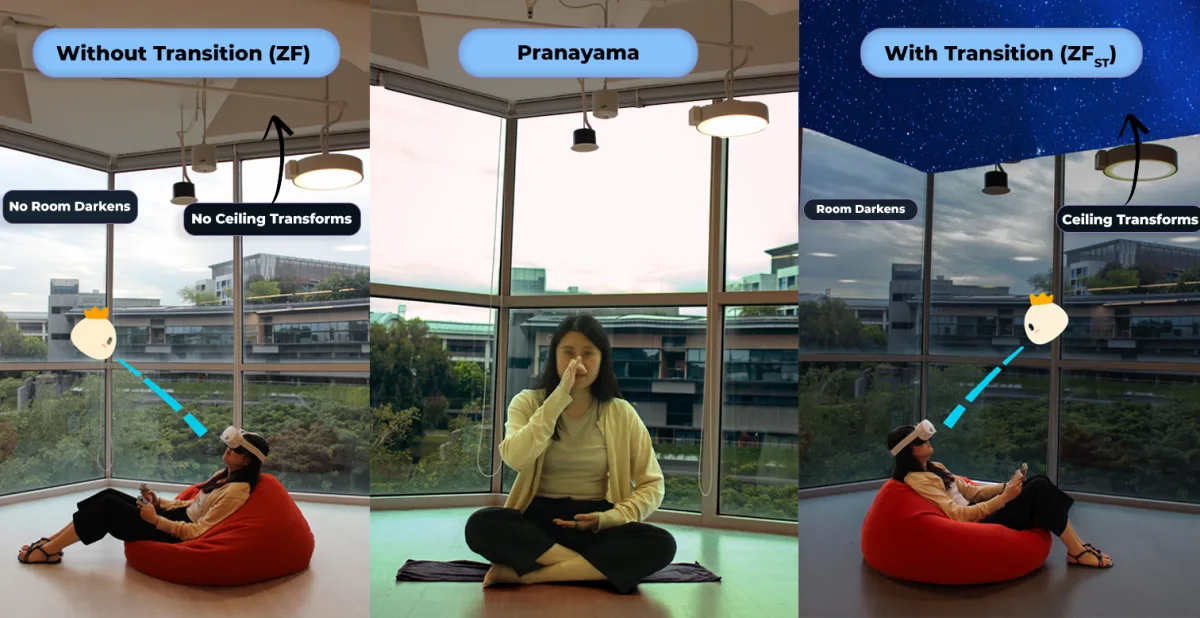
Zenflow is a mixed reality relaxation system designed to help people wind down before sleep. Instead of dropping users into a fully synthetic world, it gradually transforms the physical room into a calm night-sky environment while guiding slow breathing through light, motion, and sound.
The project was developed around a simple question: can perceptual transitions in mixed reality make relaxation practices feel more natural, less abrupt, and more effective at bedtime? The resulting system focuses on continuity, subtlety, and emotional safety rather than spectacle.
Research Context
Zenflow was presented in the paper Zenflow: Investigating MR Transitions for Enhancing Sleep and Relaxation. The system was co-designed with mental health professionals who regularly use pranayama in practice, and the design direction emerged from concerns about overstimulation, emotional triggers, and the need for a calming experience that still feels grounded in the user's real space.
That process led to several important decisions: avoid intense environmental shifts, avoid anthropomorphic guides, use a night-sky ceiling instead of forests or sunrise scenes, and keep the breathing feedback tightly synchronized so the experience feels stable and trustworthy.
How Zenflow Works
Users begin in their actual bedroom or resting space. Over the course of an approximately eight-minute session, Zenflow introduces a soft transformation overhead, revealing a star-filled sky while preserving the room's spatial context. A glowing orb guides inhalation and exhalation, giving the user a focal point for paced breathing without turning the experience into a character-driven meditation app.
The result is a transition-based relaxation flow rather than a hard switch into virtual content. That distinction is central to the project: the system is designed to lower friction before sleep by easing the user from familiar surroundings into a quieter perceptual state.
Study Design
The paper reports a three-week within-subjects study with 12 participants comparing three conditions:
- Traditional pranayama practice
- Zenflow without spatial transformation (ZF)
- Zenflow with spatial transformation (ZFST)
The evaluation combined self-reported sleep quality with physiological measures captured from a Garmin device, allowing the team to compare how different transition strategies affected both felt relaxation and pre-sleep recovery.
Key Findings
Zenflow with spatial transformation produced the strongest results. Compared with traditional pranayama, the ZFST condition showed significant improvements across all four Leeds Sleep Evaluation Questionnaire subscales, including ease of getting to sleep and perceived sleep quality. For example, the paper reports improvements of $\Delta=+7.35$ for getting to sleep and $\Delta=+8.36$ for quality of sleep.
Objective measures also moved in the same direction. During the 30 minutes before sleep, Garmin stress scores were significantly lower in the ZFST condition than in traditional pranayama, with $\Delta=-6.62$ and $p=.032$. During the first 30 minutes of sleep, participants also showed longer inter-beat intervals in ZFST than in both comparison conditions, suggesting better autonomic recovery in the early stage of sleep.
Not every measure changed. Morning perceived stress scores did not show a statistically significant difference across conditions, which makes the paper's contribution more specific and more credible: Zenflow appears especially promising as a pre-sleep transition system rather than as a broad claim about general stress reduction.
Why It Matters
Most digital wellness experiences either stay fully abstract or replace the user's surroundings outright. Zenflow explores a different design space, where mixed reality is used to gently reframe the room the user is already in. That makes the experience more spatially coherent, more appropriate for bedtime, and potentially easier to adopt as part of a nightly routine.
For FlowsXR, Zenflow represents a broader systems question: how should adaptive environments respond when the goal is not productivity or efficiency, but rest?
Next Directions
The current research points toward richer longitudinal studies, broader participant groups, and deeper exploration of how perceptual transitions can support restorative states. Future iterations can build on the same core principle: mixed reality works best here not by overwhelming the senses, but by guiding them carefully.